
The Difference Between Managing People and Developing People
Most leaders are taught how to manage people.
Far fewer are taught how to develop them.
At first glance, the two may seem similar. Both involve guiding employees, overseeing performance, and helping teams achieve goals. However, there is a significant difference between managing people and developing people—and understanding that difference can transform not only individual careers but entire organizations.
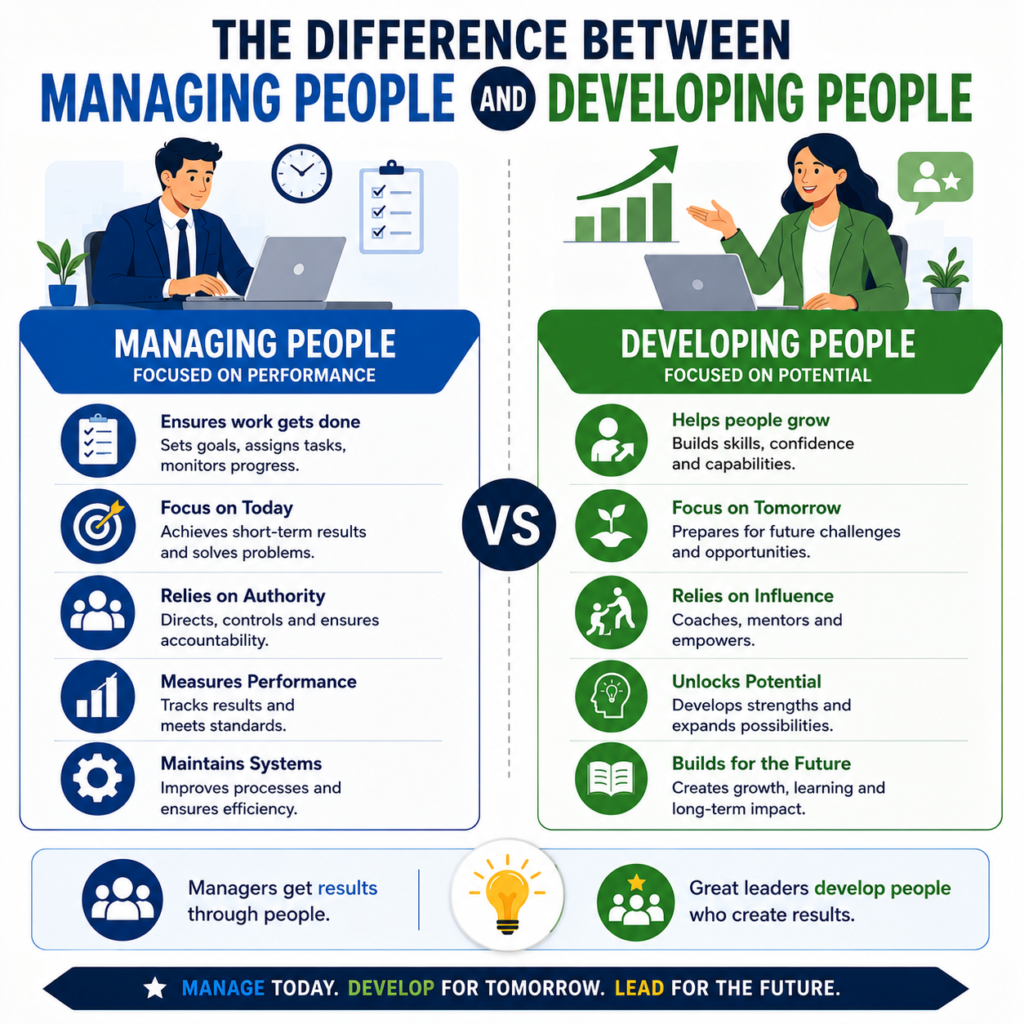
Managing People: Focused on Performance
Managing people is about ensuring work gets done efficiently and effectively. Managers assign tasks, monitor progress, solve problems, enforce policies, and ensure that business objectives are met.
In a management-focused environment, leaders typically ask questions such as:
- Is the work being completed on time?
- Are employees meeting their targets?
- Are processes being followed correctly?
- How can productivity be improved?
These are important responsibilities. Without effective management, teams can become disorganized, deadlines may be missed, and business performance can suffer.
Good managers provide structure, accountability, and direction. They help employees understand expectations and ensure that organizational goals are achieved.
However, management alone has limitations.
When leaders focus only on tasks and results, employees may perform adequately but fail to grow. They become skilled at completing assignments but may not develop the confidence, capabilities, and leadership potential needed for future challenges.
Developing People: Focused on Potential
Developing people goes beyond managing their current performance. It involves helping employees grow into the best version of themselves.
A development-focused leader asks different questions:
- What strengths does this person have?
- What skills do they need to build?
- What opportunities will help them grow?
- How can I prepare them for future responsibilities?
Instead of focusing solely on what employees are doing today, leaders focus on what employees can become tomorrow.
Development is about coaching, mentoring, providing learning opportunities, encouraging critical thinking, and helping individuals expand their capabilities.
When leaders develop people, they invest in long-term growth rather than short-term results.
The Key Difference
The simplest way to understand the distinction is this:
Managers focus on performance. Developers focus on potential.
Management ensures people achieve today’s goals.
Development prepares people to achieve tomorrow’s goals.
Both are essential, but organizations that prioritize development often create stronger teams, higher engagement, and better long-term results.
Why Development Matters More Than Ever
Today’s workplace is changing faster than ever before. Technology evolves rapidly, industries transform, and new skills become necessary almost overnight.
Organizations can no longer rely solely on hiring external talent whenever new capabilities are needed. Instead, they must build talent from within.
Employees are also seeking more than just a paycheck. They want learning opportunities, career progression, and meaningful growth.
Studies consistently show that employees are more likely to stay with organizations that invest in their development. When people feel that their employer is committed to their future, they become more engaged, motivated, and loyal.
Development is no longer a “nice-to-have.” It has become a business necessity.
What Developing People Looks Like in Practice
Developing people does not always require formal training programs or large budgets.
Sometimes, the most effective development happens through everyday leadership practices:
- Providing constructive feedback regularly.
- Encouraging employees to take ownership of projects.
- Delegating responsibilities that stretch their abilities.
- Coaching rather than simply giving answers.
- Recognizing strengths and helping employees leverage them.
- Creating opportunities for learning through real-world experiences.
A leader who develops people does not solve every problem for the team. Instead, they help team members develop the skills and confidence to solve problems themselves.
From Boss to Coach
One of the biggest shifts leaders must make is moving from being a boss to being a coach.
A boss focuses on directing.
A coach focuses on empowering.
A boss tells people what to do.
A coach helps people discover what they are capable of doing.
Coaching creates independence, confidence, and ownership. It encourages employees to think critically, make decisions, and continuously improve.
This approach not only benefits employees but also reduces dependence on managers, allowing leaders to focus on strategic priorities rather than constant supervision.
Building a Culture of Growth
Organizations that thrive in the long run understand that their greatest asset is their people.
Managing people helps businesses operate efficiently.
Developing people helps businesses grow sustainably.
The most successful leaders know that their role is not simply to oversee work. Their role is to unlock potential, nurture talent, and create future leaders.
Because at the end of the day, great managers get results through people.
Great leaders leave behind something even more valuable: people who continue to create results long after they are gone.