
7 Ways On How to Build a Talent Pipeline Before You Actually Need One
By Symphony Tech Solutions & Consultancy
Most companies hire the same way they fight fires — reactively, urgently, and under pressure.
A critical role opens. The team is stretched. The hiring manager wants someone yesterday. And suddenly, every decision made in the next 30 days carries outsized risk — because there’s no time to be careful.
This is the cost of not having a talent pipeline. And it’s more expensive than most organisations realise.
A bad hire can cost up to five times that employee’s annual salary. Roles left vacant too long quietly erode team morale, miss revenue targets, and push your best people toward the exit. According to SHRM, the average time-to-fill across industries sits at 44 days — and for specialised or senior roles, that number climbs significantly higher.
The solution isn’t to hire faster. It’s to stop starting from zero every time.

What Is a Talent Pipeline — And Why Most Companies Don’t Have One
A talent pipeline is a pre-built pool of qualified, relationship-ready candidates — both internal and external — who can step into critical roles when the moment comes. It isn’t a spreadsheet of old CVs. It isn’t a passive candidate database that no one ever looks at. It’s an active, ongoing investment in future hiring capacity.
The distinction matters: reactive recruitment fills roles. A talent pipeline builds organisational resilience.
And yet, most companies still operate without one. The reason is almost always the same — pipeline building feels non-urgent until the moment it becomes critical. At that point, it’s too late to build one.
The Real Cost of Reactive Hiring
Before getting into the how, it’s worth naming the problem clearly.
When a company hires reactively, several things happen simultaneously:
Compressed decision-making. When a role must be filled quickly, “good enough” replaces “right fit.” Hiring managers shortlist faster, reference-check less carefully, and occasionally skip assessments altogether.
Negotiating from weakness. Urgency is visible to candidates. When organisations signal desperation, top candidates extract higher packages or take longer to decide — because they know you need them more than they need you.
Team strain accumulates. Every week a critical role sits vacant, someone else on the team absorbs the workload. Over time, this compounds into burnout and attrition — creating more vacancies to fill reactively.
Quality of hire drops. Cornerstone research shows proactive talent pipelines reduce recruitment time from 170 days to 60. The inverse is also true: reactive hiring compresses that window in ways that hurt hire quality.
The cost isn’t just financial. It’s structural.
Who Should Be in Your Talent Pipeline
A common mistake is building a pipeline for only the roles currently hardest to fill. In reality, a strong pipeline covers three distinct groups:
1. Critical role candidates (external) These are the people who could step into your highest-leverage positions — leadership roles, specialised technical functions, or revenue-critical spots — even if none of those roles are currently open. They may be passive candidates: highly capable professionals who aren’t actively looking but would consider a compelling opportunity.
2. Internal high-potentials The most overlooked part of any talent pipeline. According to Cornerstone, internal hires ramp faster and bring institutional knowledge that external candidates cannot. Identifying, developing, and tracking employees with high growth potential is pipeline management — it just happens inside the organisation.
3. Near-ready candidates in your network These are the second-round interviewees from past searches, strong referrals who didn’t match the timing, alumni from previous companies, or university partnerships. People who already know your organisation or come pre-endorsed carry significantly less risk than cold sourcing.
How to Build a Talent Pipeline: A Practical Framework
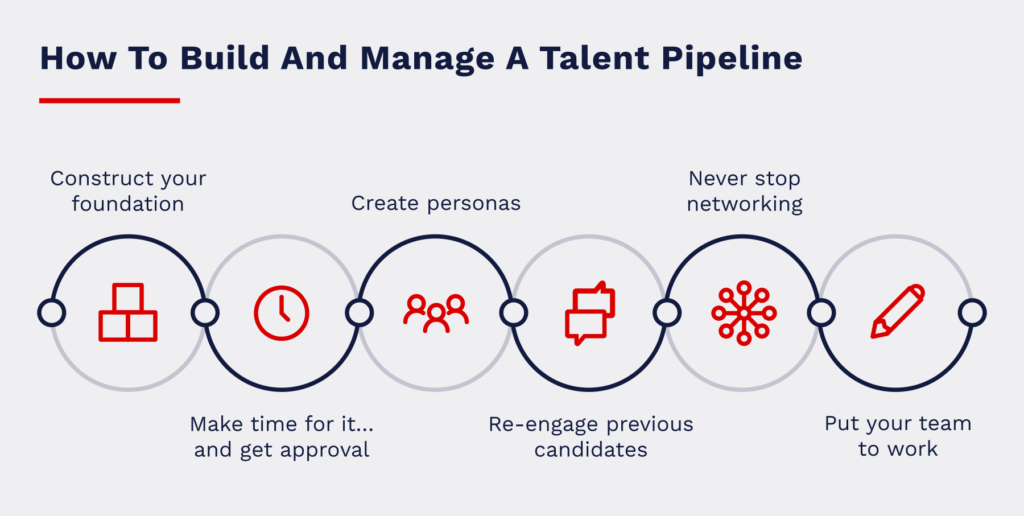
Step 1: Map Future Talent Needs Against Business Direction
Pipeline building starts with a question most HR functions aren’t asked: Where is this organisation going in the next two to five years?
Expansion plans, new service lines, leadership transitions, technology shifts — all of these create predictable future talent needs. The goal isn’t to predict every hire, but to identify the categories of roles that will become critical and start sourcing for those profiles now.
Work backward from business strategy. If the company is entering a new market in 18 months, the talent to lead that market entry needs to exist in your pipeline today.
Step 2: Identify and Segment Your Talent Pool
Not everyone in your pipeline requires the same level of engagement. Segment candidates by readiness, seniority, and role type:
- Hire-ready now: Candidates who could realistically receive an offer within 30–60 days
- Developing: Strong profiles who need 6–12 months of relationship-building or skill development
- Future watch: High-potential early-career candidates worth tracking over a longer horizon
Internal talent should be mapped with the same rigour. Skills assessments, manager feedback, and career conversations are the tools that make this visible.
Step 3: Build and Protect Your Employer Brand
Passive candidates — the most valuable segment of any talent pipeline — don’t apply to job ads. They respond to reputations.
Your employer brand is what people say about working at your organisation when you’re not in the room. It shapes whether top candidates return your message, attend your event, or accept your call.
Research from HR.com found that only 28% of HR professionals have a comprehensive, consistently implemented employer branding strategy. Yet this is one of the highest-leverage investments an organisation can make in long-term talent attraction.
Practically, employer brand lives in: Glassdoor responses, LinkedIn content from leadership, employee testimonials, how candidates are treated during interviews, and the stories your current employees tell their networks.
Step 4: Engage Consistently Not Just When You’re Hiring
A pipeline is only as strong as the relationships in it. Candidates who haven’t heard from you in 18 months are not in your pipeline. They’re in someone else’s.
Consistent, low-pressure engagement keeps your organisation visible and your relationships warm. This doesn’t require heavy investment:
- A quarterly newsletter with industry insights
- Invitations to company webinars or events
- A LinkedIn comment on a candidate’s milestone post
- A brief check-in from a hiring manager or recruiter
The goal is top-of-mind presence, not recruitment pressure. When a role does open, the conversation picks up naturally — not awkwardly.
Step 5: Develop Internal Talent Intentionally
The best pipeline for most organisations is the one that already works for them: their own people.
Internal mobility reduces hiring costs, improves retention, and creates the kind of career growth employees cite most often when they decide to stay. But it doesn’t happen by accident. It requires:
- Clear competency frameworks for each critical role
- Regular career development conversations (not annual performance reviews)
- Stretch assignments that build readiness
- Succession planning that names multiple candidates per key role, not just one
When an organisation is known for developing people from within, it also improves external hiring. Candidates at every level are more likely to join a company where they can see a credible path forward.
Step 6: Use Technology to Scale What You Can’t Do Manually
At a certain pipeline size, manual tracking breaks down. An ATS or CRM built for recruitment keeps candidate data organised, tracks relationship history, flags engagement gaps, and surfaces high-potential profiles when roles open.
AI-based tools are now being used by 38% of HR leaders to identify candidates and reduce time-to-hire by up to five times. For most mid-to-large organisations, these are no longer optional. They are competitive infrastructure.
The caveat: technology organises your pipeline. It doesn’t build it. Relationships, employer brand, and internal development remain human work.
Step 7: Measure What Matters
A pipeline is only valuable if it’s maintained. And it’s only maintained if someone is accountable for its health.
The metrics that matter are:
- Time-to-fill from pipeline (vs. cold sourcing): Are pipeline hires faster?
- Pool size by critical role category: Are you covered for the roles that matter most?
- Engagement rate: Are candidates in your pipeline responding to outreach?
- Conversion rate: What percentage of pipeline candidates eventually become hires?
- Internal promotion rate: Is the pipeline developing talent upward?
Track these quarterly. Share them with leadership as business metrics, not HR metrics — because they are.
The Internal Pipeline: A Note on What Most Companies Miss
External pipeline management gets most of the attention. Internal talent development gets most of the actual results.
The data is consistent: internal hires ramp faster, cost less to onboard, and stay longer. Yet many organisations have no formal process for identifying high-potential employees, no succession plans beyond the top two or three leadership roles, and no structured development pathways to build readiness.
High-potential employees who don’t see a path forward don’t stay quiet. They leave — often to competitors who spotted the same potential and offered a clearer future.
Building an internal pipeline means creating career visibility, not just career opportunity. Employees need to see what growth looks like, believe it’s accessible to them, and trust that the organisation will invest in getting them there.
Common Mistakes That Undermine Talent Pipelines
Building it only for senior roles. Critical roles exist at every level. A pipeline that only covers leadership gaps will still leave operational teams vulnerable.
Engaging candidates only when hiring. This is the fastest way to lose goodwill. Passive candidates remember who only called when they needed something.
Treating the pipeline as an HR project, not a business one. Pipeline health is a business continuity issue. When leadership owns it alongside HR, it gets the investment it requires.
Forgetting to re-engage stale candidates. A pipeline that isn’t refreshed becomes a graveyard of outdated contacts. Regular check-ins and annual list hygiene are non-negotiable.
Measuring inputs instead of outputs. Pipeline size is a vanity metric. What matters is pipeline quality — how many people in that pool could realistically be hired into a critical role in the next 90 days.
The Bottom Line
Talent pipeline building isn’t a recruitment project. It’s a strategic business function.
The organisations that consistently attract, develop, and retain the right people don’t get lucky. They build infrastructure — relationships, brand, internal development, and data — before they ever need to use it.
The time to build a pipeline is when you don’t need to hire.
Because when you do, there won’t be time.